Applies to Bangladesh
How to calculate overtime pay in Bangladesh, with a worked example
The overtime formula under the Bangladesh Labour Act, the 208-hour divisor, and the three mistakes we see most often in payroll sheets.
Overtime is where most month-end payroll mistakes hide. The rule itself is short, but it gets applied to the wrong base, with the wrong divisor, or to hours that were never approved. This guide walks through the calculation once, with real numbers.
What the law says
Under the Bangladesh Labour Act, 2006, a worker’s normal working day is 8 hours. Hours beyond that are overtime, and Section 108 says overtime is paid at twice the ordinary rate of basic wage plus dearness allowance, if any.
Overtime is paid on the basic wage, not the gross. Using gross is the single most common error we see.
The formula
Many companies convert the monthly basic to an hourly rate using 208 hours (26 working days × 8 hours):
- Hourly basic = monthly basic ÷ 208
- Overtime rate = hourly basic × 2
- Overtime pay = overtime rate × overtime hours
Check which divisor your company policy uses and apply it the same way every month.
A worked example
Rahim earns a basic of BDT 12,000 and worked 20 approved overtime hours in October.
| Step | Calculation | Result (BDT) |
|---|---|---|
| Hourly basic | 12,000 ÷ 208 | 57.69 |
| Overtime rate | 57.69 × 2 | 115.38 |
| Overtime pay | 115.38 × 20 | 2,307.69 |
Three mistakes to avoid
1. Paying on gross
Gross includes house rent, medical and conveyance. Overtime is on basic. On a BDT 20,000 gross, that difference can nearly double the cost.
2. Counting unapproved minutes
Someone who punches out 12 minutes late hasn’t necessarily worked overtime. Decide on a minimum (often 30 minutes) and whether overtime needs approval in advance.
3. Rounding each day
Round the month’s total, not each day. Daily rounding quietly adds or removes hours across a large team.
Let the system do it
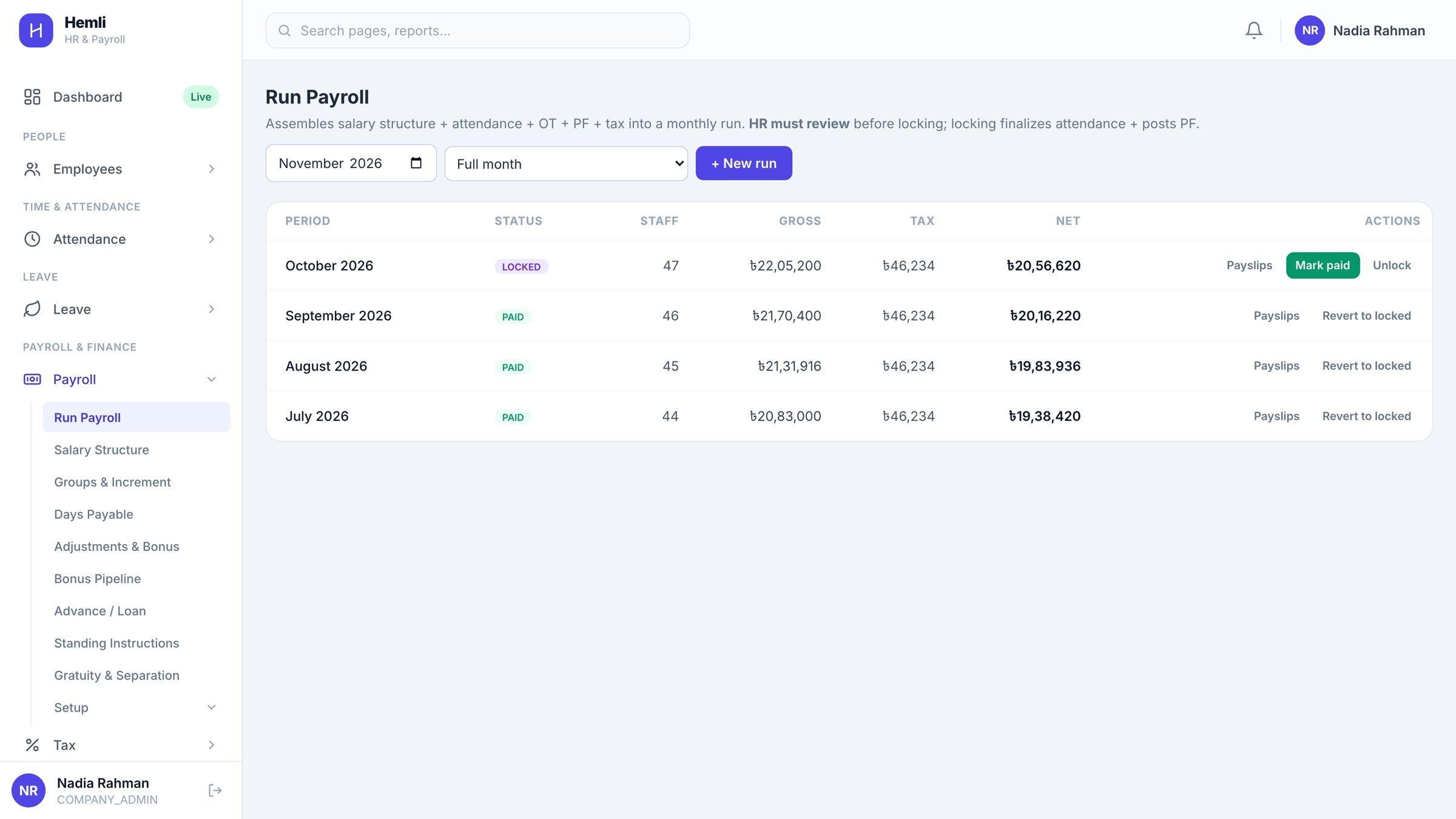
If your device already records punches, overtime doesn’t need to be typed in by hand. Hemli HR reads the punches, applies your minimum-overtime and approval rules, and puts the amount on the payslip.
This article is general guidance, not legal advice. For a specific case, check the Act and your company’s policy.